The Slow Death of Electronic Music
From the Biblo Insight Team
electronic music markus wormstrom star wars
by Markus Wormstrom
Listen to this article
In 2022, I was asked to write the music for the Star Wars short film Aau’s Song. I had nine months to compose it, which is a long time. I write a lot of music for advertising, so I’m used to unrealistic short deadlines. I started composing confident that I would create a beautiful, well-crafted piece of music. But after our first review with Lucas films, seven months later, it was clear that I had shat the bed. My rare optimism bias was replaced with my familiar imposter syndrome, and I was convinced I would be taken off the film. This would not only be a financial disaster, as I’d turned down other projects, but would no doubt also be a blow to my, so-called, reputation.
Being taken off a project is always possible in my line of work. Take the Icelandic film composer Jóhann Jóhannsson, for instance. He worked with director Denis Villeneuve on early films, writing the original soundtrack for the films Prisoners (2013), Sicario (2015) and Arrival (2016). But it was taken off Villeneuve’s most significant project at the time, Blade Runner 2049. In September 2017, Villeneuve told Screenrant that “Jóhann Jóhannsson is one of my favourite composers alive today. But the movie needed something different, and I needed to go back to something closer to Vangelis. Johan and I decided that I would need to go in another direction—that’s what I will say. I hope I have the chance to work with him again because I think he’s really a fantastic composer.”
Jóhannsson died of a drug overdose less than four months after that quote was given. He died alone in a hotel room in Berlin. I haven’t heard anyone else make this connection, though it was so painfully obvious to me. Being taken off a film as a composer is always a real threat with real consequences.
I went into a slump and started asking myself why I ever got into this business. I traced the source of my fascination back to one specific afternoon. Anyone who grew up in the 80s with an appreciation for electronic music has a ‘the first time I heard Aphex Twin’ story. Mine was in my cousin’s room, tripping on mushrooms, listening to the latest Nine Inch Nails release, Further Down The Spiral (1995). This was Aphex Twin’s first US exposure. For those who don’t speak nerd, this means that the guy who scored Gone Girl introduced North America to the experimental electronic music that had begun to develop in the UK in the early 90s. Experimental electronic music, when combined with psychedelics, evokes synesthesia but more than colors; it’s environments where sounds have haptic qualities.
The song is called At The Heart Of It All, and it’s like a train made of knives scraping through your brain. I had never heard anything like it. It was slow and dramatic, like the Ravel my father used to play. It is more akin to Prokofiev than industrial music, which is what we were into at the time. Our music was so aggressive back then, but this had another feeling altogether.
My cousins and I stayed across from a park where we spent most of our adolescence. We’d go there most afternoons to ‘walk the dogs,’ which was code for smoking pot and listening to music on a boombox.
We were bugging out on this mysterious artist Aphex Twin but could find very little info on him. This was the 90s, Hammer Time, and finding CDs of an obscure artist was no easy feat. Thankfully, we had a wealthy friend who, on a trip to New York, brought back tons of Aphex Twin and some similar artists, Autechre.
He brought back a ton of information, too. Aphex Twin’s real name was Richard D. James. His bio is filled with many strange half-truths disseminated to further the mystery around him. He was first compared to Mozart in 1994 by Mojo magazine, and its comparison has stayed with him throughout his career. Despite his strange nature and obvious disdain for any limelight, Aphex Twin is a near archetypal figure at the heart of all electronic music. His synth collection is legendary, and so is his drum machine programming and step sequencing. His genius, apart from his natural talent for melody and counterpoint, is his syncopation and rhythm. It can’t be matched precisely because he uses old gear that’s very hard to come by.
Autechre, his early 90s contemporaries, is an electronic duo from Manchester, Booth, and Brown. Like Richard, they were pioneers of this new experimental sound through the late 80’s and 90’s but seemed to achieve unanimity with more success than Richard. In that scene, it was never about the artist but rather the music. It was about programming and making machines make sounds never heard before. Someone coined the term IDM, short for Intelligent Dance Music, which everyone hates. I much prefer the umbrella term experimental electronic music.
These early pioneers were technically gifted; they were programmers. Everyone was obsessed with how they, Autechre specifically, generated their sound, as it was a complete mystery to anyone who heard it. There were entire websites and messageboards dedicated to these questions. Some interviews can still be found online.
To this day, my favourite Autechre album is Chiastic Slide (1997). It has complex and exciting rhythms in uncommon time signatures. Their sound is haptic; the drums sound like pistons, propellers, and jet engines. It stands the test of time; their unique approach is still unmatched by modern electronic music. This is perhaps because it was programmed on an Atari sequencer, triggering external analog synthesizers.
These old analog synthesizers sound so good because it’s the sound of pure electricity. The waveform isn’t generated digitally but rather flows through a circuit board in a similar way as water. It’s not the most sophisticated comparison, I know, but it holds true. The sound produced by a speaker is shaped by electricity. The oscillator generates a waveform, either sine or square, etc. The current moves through the system, further manipulated by effects that filter or perhaps duplicate it in an endless array of options. This electric current then flows out the output and into a speaker, where it manipulates the magnetic field of a magnet, which in turn vibrates the speaker cone, thereby transmitting the shape of the electricity into the air in front of the speaker cone. This moves the air in a room, as well as our eardrums, and the next thing you know, you’re dancing.
Once a sound is digitized, however, that’s to say, recorded onto a computer, the sound is converted into data, 1 and 0’s. If you zoom into a sound file on a computer closely enough, you will see little, square blocks or bits. These represent the digital information of a sound. So when the electricity flows from a computer, there are tiny, imperceivable, jagged movements in the speaker cone producing the sound. Whereas analog is different. There are no bits, just the natural flow of electricity as pure and real as a bird song. Techno heads are real Puritans when it comes to this sort of thing. Sometimes, their music is never digitized. They record their analog sequences on reel-to-reel tape machines from the 70’s and send it to the vinyl press without digitizing the signal. The reason for this is the purity.
Autechre and Aphex Twin have both continued to release music thirty years later; they are cemented into the collective culture, forever synonymous with the advent of experimental electronic music. But I personally feel that Autechre has plateaued since then; their generated algorithmic and microtonal compositions seem devoid of personality. It’s a bit much and hard to listen to. I should be clear that I am a massive Autechre fan, and I’d go so far as to say that their song Rae, released on LP5 (1998) is the greatest electronic composition in history. A pretty big statement, I know, but let me elaborate. First, Autechre isn’t known for its melodies and counterpoint, but in LP, it displays a surprisingly deep knowledge of chord development. Rae, the 3rd song on the first of their unnamed EPs (only known as LP5), starts with a bang, which is mature as many lesser electronic composers tend to want to build a song over time. It begins fully formed, then slowly dissolves over the 5 minutes. Listening to it now, 25 years later, I have no idea how the drums were programmed or perhaps generated by an algorithm. The sound is bold and upbeat, but after 2 minutes, it begins to disintegrate. The tempo starts to change, which is usually a cardinal sin in electronic music, and then something very interesting happens as it slows down its shifts from a classic 4/4 signature into a triplet. The song becomes deeply emotive with a soothing synth line that always seems to me to say “toe maar,” an Afrikaans phrase you’d say to a child, something akin to “it’s all going to be ok.” This probably reveals something about me and why I was drawn to electronics as an adolescent.
I only mention my connection to this song to illustrate that it’s hard for me to say that, in my opinion, Autechre has plateaued creatively since then despite the cutting-edge tools at its disposal.
So why is it that Aphex Twin has remained relevant and not them? The answer is simple: analog gear. Aphex remained focused on analog synthesis to a point where his interactions with these machines seemed unnatural; he’s like an athlete, a sort of aural cyborg. The Mozart of our generation.
I sat down with a well-known producer friend of mine to chat about his vintage gear. He asked to remain anonymous under threat that someone will steal his stuff. He’s one of South Africa’s leading musical exports whose music has millions of listeners across the planet. But I didnt reach out to him to talk about his music; rather, I wanted to talk about something that only a few people know. He is also one of the most prolific gear hoarders in the world.
When I first met him, he was a downhill skater, winning many competitions. He is a bit younger than me, and when he told me he would be a rapper, I treated him with some skeptical remarks. Fifteen years later, there’s egg on my face, as he’s killing it.
“It all started,” he says, passing a cup of matcha,” when I found this old Jupiter 8 in a guy’s garage. I knew it was something special, but I did not realize what it would lead to.” A Jupiter 8 was first released in 1981 and recently became famous when it was featured throughout the Stranger Things soundtrack. We’re chilling in his Houtbay flat, a town near Cape Town, talking music and gear. “3 months later, someone offered me 2 times what I paid for it.” He laughs. “Every year, someone offers me more for it. Someone recently offered me 6 times what I paid for it.”
That’s what we’re talking about, the way that old synthesizers appreciate in value; the older they are, the more valuable they become. But he uses it in all his productions and has no plan to sell it. Isn’t this just the very definition of an appreciating asset? Asset being the key word here; something that generates income while growing in value.
His collection grew over the years, filling his first studio, which was still in his parent’s basement. He recently moved it all to another, much more secure underground location.
The issue, of course, is maintaining these old machines. He once found a sought-after Lexicon reverb unit in a dusty garage. He repaired it by replacing its CPU with a 2 megahertz chip he dug out of an old 80’s game machine. “The real issue is vacuum tubes. No one produces them anymore; if someone did, it would have to be in mass.” But he tells me he has hoarded enough of them to last two generations.
Our conversation drifts to why people are so obsessed with old machines and microphones; he thinks it’s nostalgia.
The Roland 909 drum machine is the holy grail for some producers trying to capture an ‘authentic’ old-school sound. But when it was taken to market in the early 80’s, it was considered a flop and not well respected. But it was cheap and was used on all early hip-hop tracks. So now, despite the early sentiment, it now evokes nostalgia, and its value has increased over time.
Perhaps this is where Jóhann Jóhannsson went wrong while composing the score for Villeneuve’s Blade Runner. Maybe he was trying to create something new, not as close enough to the original 1982 film score. Afterall, Villeneuve said, “I needed to go back to something closer to Vangelis.” Vangelis, the legendary cinematic composer, famously used the CS-80 synthesizer for the original Blade Runner soundtrack. Hans Zimmer used a CS-80 when he took over composition for Blade Runner 2049. Perhaps it never occurred to Jóhann that the instrument is sometimes more valuable than the artist.
I went into a spin after that first review with Lucas films. Then my wife, generally an anxious person but who always keeps a cool head in a crisis, reminded me that it was just a review and that my head was playing tricks on me again. She was right; I figured it out. In the end, our episode was rated number 1 by Screen Rant for that season. They even commented on the music, saying, “The music and sound design are breathtaking, seamlessly blending with the animation to create the episode’s atmosphere.” So I got to see another day.
The solution to what my Star Wars film was missing is surprising. I initially saved no expense. I recorded the Cape Town Youth Choir in St. Mary’s Cathedral on twenty-two microphones and worked with the modern sound manipulator tool called Reformer to transform the choir’s voices into crystal shards and, so doing, create Kyber crystal’s theme, but that wasn’t enough. In the end, it wasn’t any of the modern tools at my disposal that did the job, but rather an old dusty synth, half-forgotten on a shelf in the back of my house.
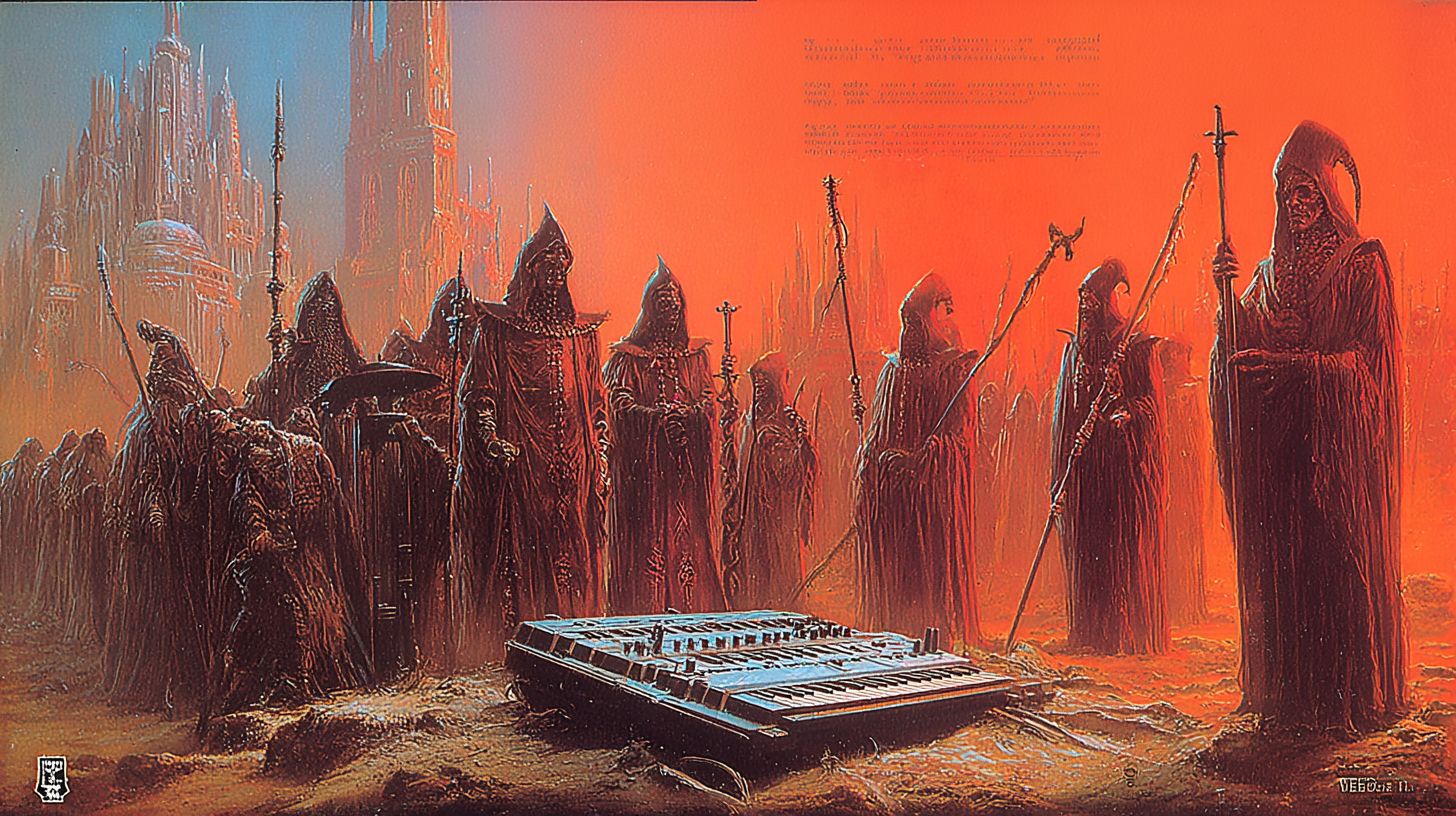
The Roland SH1000 was released in 1972. It is the first mobile synth. It is monophonic, which means you can press one note at a time, and has a single oscillator, as opposed to a modern synth like the Virus, which has 1800 oscillators. An oscillator is the part of a synthesizer that generates the initial electric signal that flows through the system’s components like effects and filters, etc.
When we started working with the synth, the film suddenly came alive, and the texture that the directors were after appeared almost effortlessly. It felt like cheating in comparison to what we had; playing this instrument live through analog effects added a depth I couldn’t achieve otherwise.
I guess I was just lucky to have the right synth laying around. Growing up poor, I never had the luxury of hoarding gear. I always focused on the tools at my disposal. I felt that hours and craft make art. I felt everyone’s fascination with old analog machines was nostalgia. But, this experience changed me, and I have a much deeper appreciation for analog synthesis. It feels to me that we have not furthered the technology much in fifty years. There has been a lot of development, sure, but has it gotten better? If it has, then why do we fixate on these old machines? Are we simply longing for a simpler time, or has the technology plateaued?